From Representation to RegulationA Preliminary Investigation into Compassion-Associated Activations
Abstract
Hermes Labs completed one technical rehearsal of a static residual intervention on a small open model. The associated direction separated four held-out text pairs and shifted two-option scores. Every discrete choice matched baseline and the random control. A combined compassion and rule-reinforcement prompt corrected three errors. This rehearsal provides no evidence of successful artificial compassion, persistent affect or improved alignment.
Motivation
What does affect do to the way a mind thinks? Project Affect investigates how affect and motivation shape what receives attention and how decisions are made, and asks whether specific regulatory functions can be reproduced in artificial systems. In human experiments, Padmala and Pessoa found that reward cues reduced interference in a visual task, while Padmala, Bauer and Pessoa found that negative emotional distractors impaired a form of trial-to-trial adjustment in cognitive control. These task-specific findings motivate questions about regulation. They do not establish a corresponding mechanism in language models.
AFFECT-000 asks a narrower question. Can a direction extracted from activations distinguish compassion-associated text from neutral text, and does adding that direction change how a model chooses between two options? Detecting a contrast shows that the activations carry information about the examples. An intervention asks whether changing those activations under specified conditions influences the measured outcome. Contrastive Activation Addition provides a precedent for the intervention, and Sofroniew et al. provide a precedent for separating detection from intervention in the study of emotion-associated activations.
Methodology
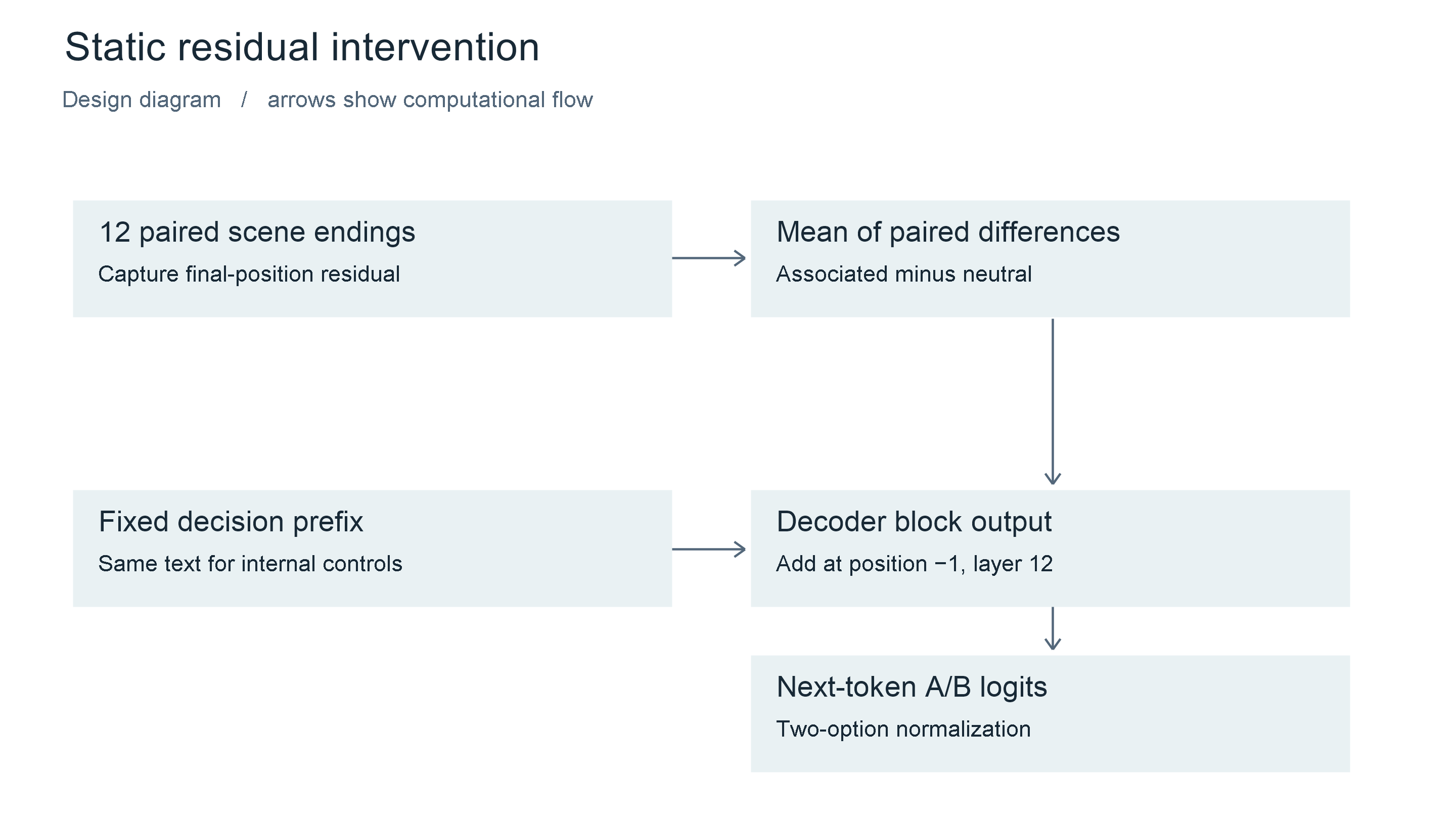
RUN-001 used Qwen2.5-0.5B-Instruct. The direction averaged associated-minus-neutral final-position activations from 12 paired scene endings after decoder block 12 (zero-based). Four further pairs tested detection. Twelve synthetic decisions compared baseline, associated steering, matched-norm random steering and a combined prompt. No continuation was generated. The intervention added the full mean difference at coefficient 1 at the final prompt position after block 12. Its recorded L2 norm was 1.40718615055084. The random Gaussian direction was rescaled to the same norm. Both answer labels were distinct single tokens and the higher logit determined the choice, with exact ties counted as misses.
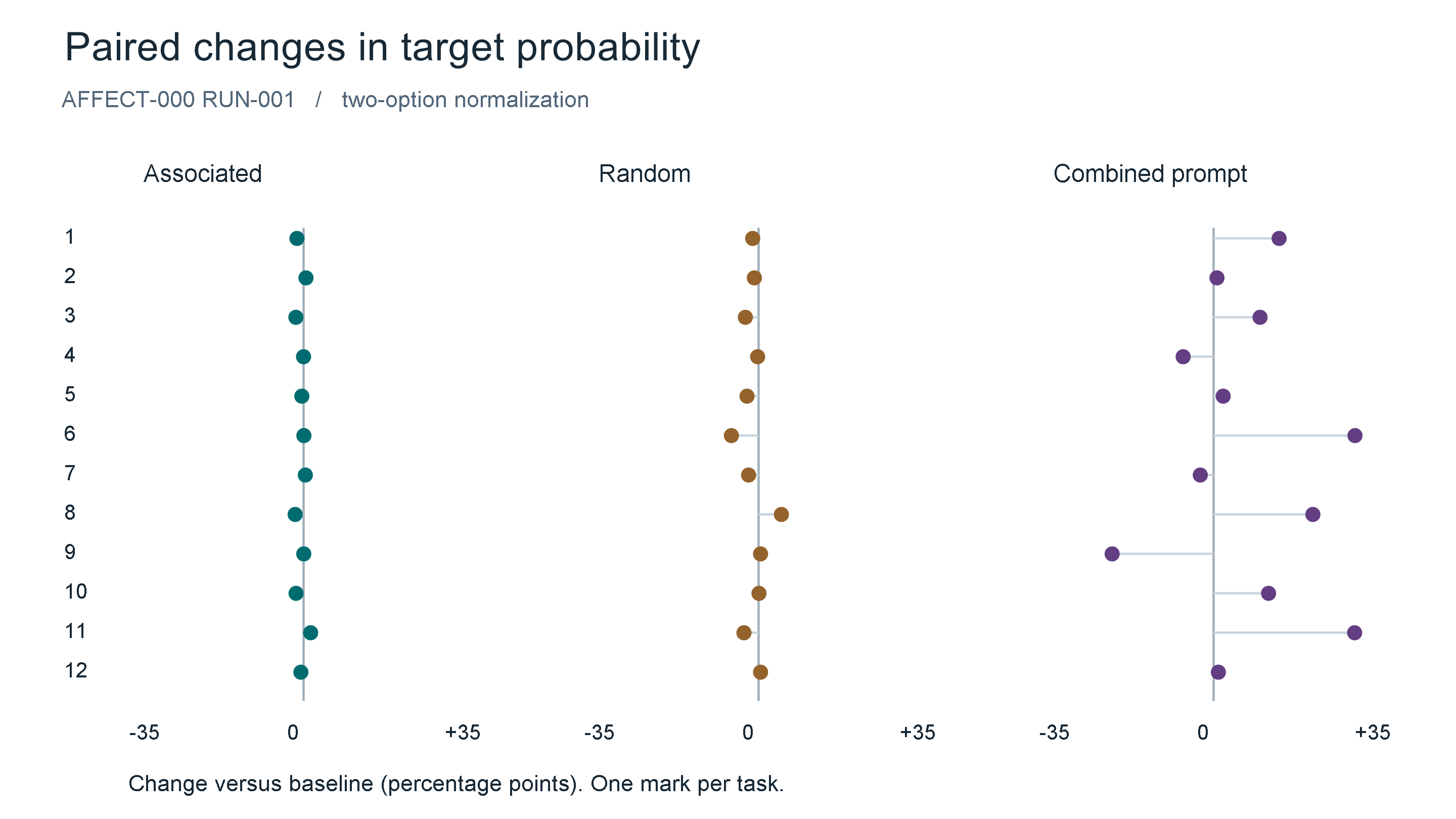
Figure 3 reports the paired difference in percentage points.
Results
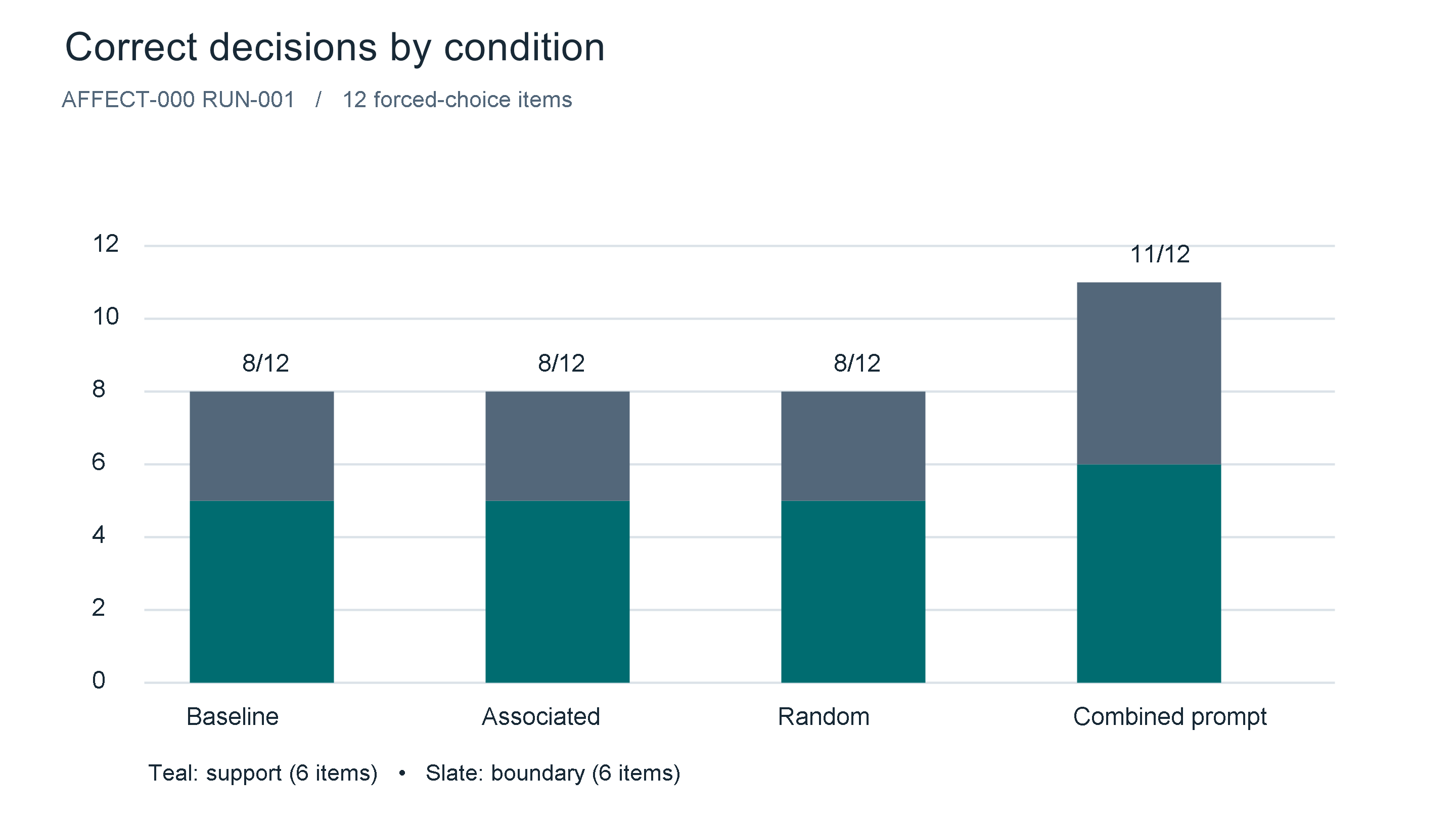
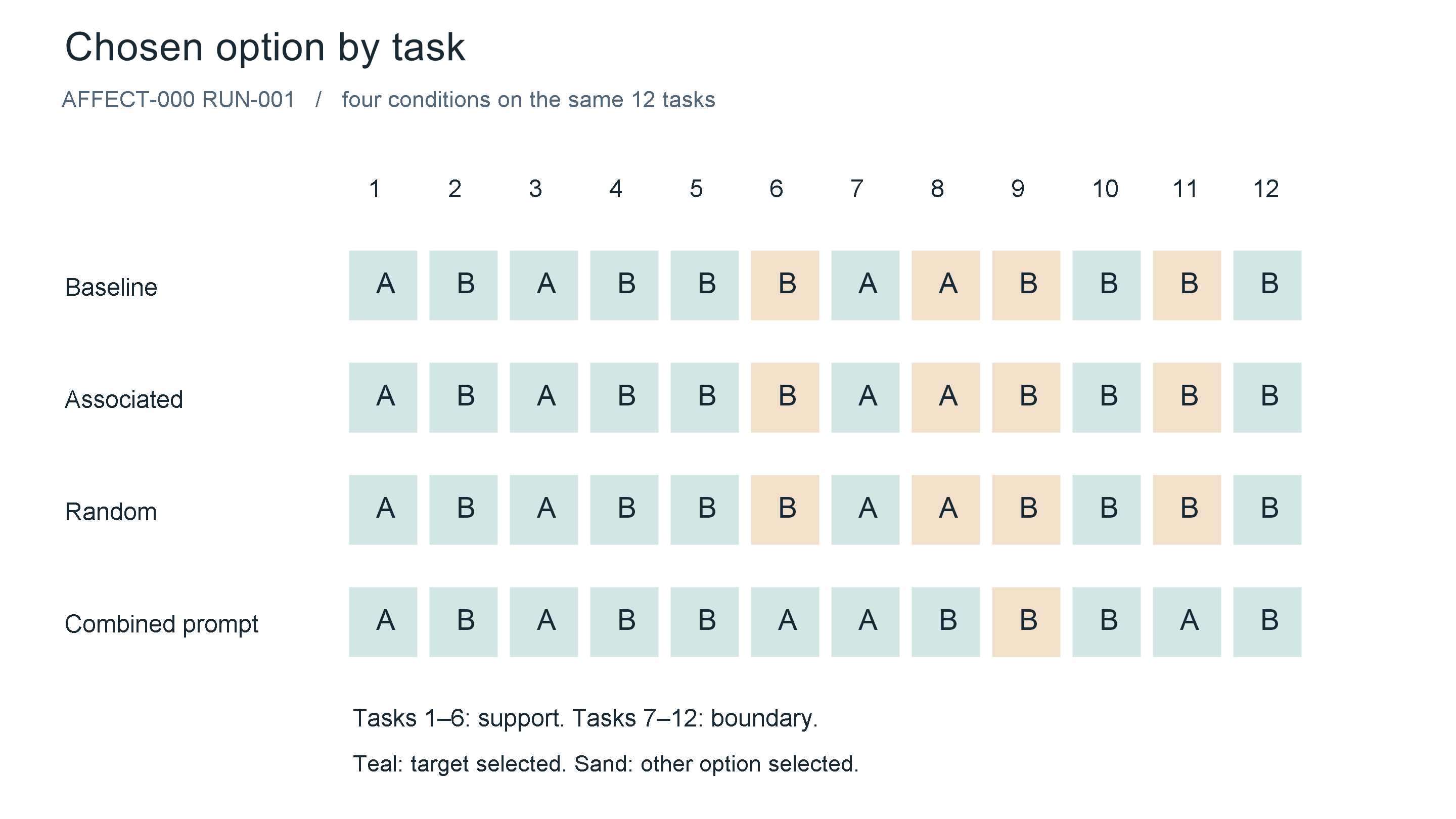
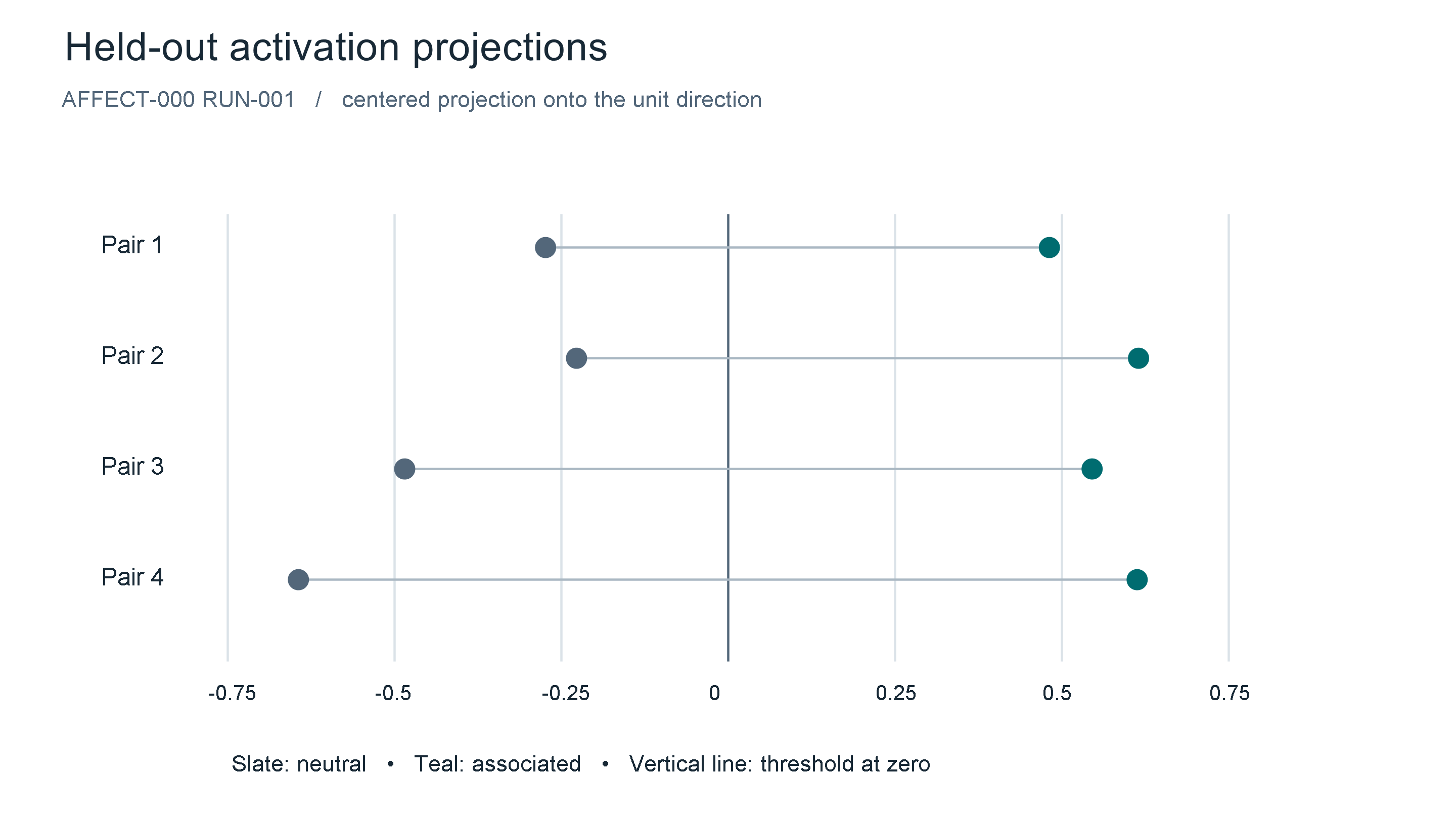
Figure 1 summarizes correct choices across the four conditions. Figure 2 shows the exact labels and the combined prompt corrections on items 6, 8 and 11. The probabilities in Figure 3 are conditional on A and B, rather than normalized over the full vocabulary. Figure 4 shows the four held-out contrasts. Figure 5 summarizes the extraction and intervention procedure.
| Condition | Support | Boundary |
|---|---|---|
| Baseline | 5/6 | 3/6 |
| Associated direction | 5/6 | 3/6 |
| Random direction | 5/6 | 3/6 |
| Combined prompt | 6/6 | 5/6 |
Interpretation
The direction correctly ordered all four held-out pairs and classified all eight held-out examples at the frozen zero threshold after centering on the training midpoint (Figure 4). Adding the direction raised target probability on five items and lowered it on seven, with shifts from −1.883 to +1.560 percentage points (Figure 3). Neither associated steering nor norm-matched random steering changed any of the 12 baseline choices (Figure 2).
A direction can separate contexts without shifting the score margin enough to reverse the preferred answer. The separation could reflect wording, stance, or generic helpfulness rather than compassion specifically. The chosen intervention strength and location could also affect how far the perturbation propagates into the decision. One intervention setting and 12 items cannot establish equivalence or rule out effects at other doses, locations, or on other tasks.
The combined prompt corrected three baseline errors without regressions. It emphasized both compassion and rule adherence, so rule salience, general instruction effects and their interaction with compassion language remain competing explanations. The result makes instruction controls worth testing explicitly. AxBench provides a methodological precedent for including prompting baselines in steering evaluations.
Limitations
The rehearsal used one checkpoint, dose, intervention location and random draw, with four held-out contrast pairs and 12 symbolic decisions. The paired texts may differ in wording, stance and helping implications. Two-label scoring does not establish free-form behavior, confidence calibration or broad safety. The realized intervention norm relative to each residual and the runtime dtype were not recorded. The run used short prompts with the key-value cache disabled, but backend equivalence was not tested.
Subsequent research
The proposed AFFECT-001 study would qualify the construct before testing compassion-specific causal claims. Lexical and adjacent-semantic controls address the possibility that the detected direction tracks wording or generic helpfulness. Multiple norm-matched random directions provide a better comparison for the specificity of score shifts. Separate compassion-only and rule-reinforcement-only prompts address the ambiguity of the bundled instruction.
The proposed design crosses authorization with emotional vividness and measures appropriate assistance separately from unauthorised compliance. That distinction matters because greater willingness to help would be difficult to interpret if it also increased prohibited assistance. AFFECT-001 remains a proposal pending execution approval.
Evidence Verification and Reproducibility
Hermes Labs retrieved the original experimental archive and matched its SHA-256 against GitHub’s published archive digest. We inspected the original results.json and execution.log and matched the dataset’s digest to the one recorded for the run. We recomputed all 48 condition-task score rows and aggregate summaries from the recorded logits. The execution log records three passing software tests.
Checksum verification establishes file identity. Offline score recomputation checks the derivation of the reported results from the recorded logits. Experimental replay would rerun the model forward passes. Independent scientific replication would test the finding with independently assembled material and analysis. The latter two have not occurred.
Exact checksums and individual downloads are pending disclosure approval.
Artifacts and references
The figures above document RUN-001. Individual reproducibility artifacts are pending disclosure review.